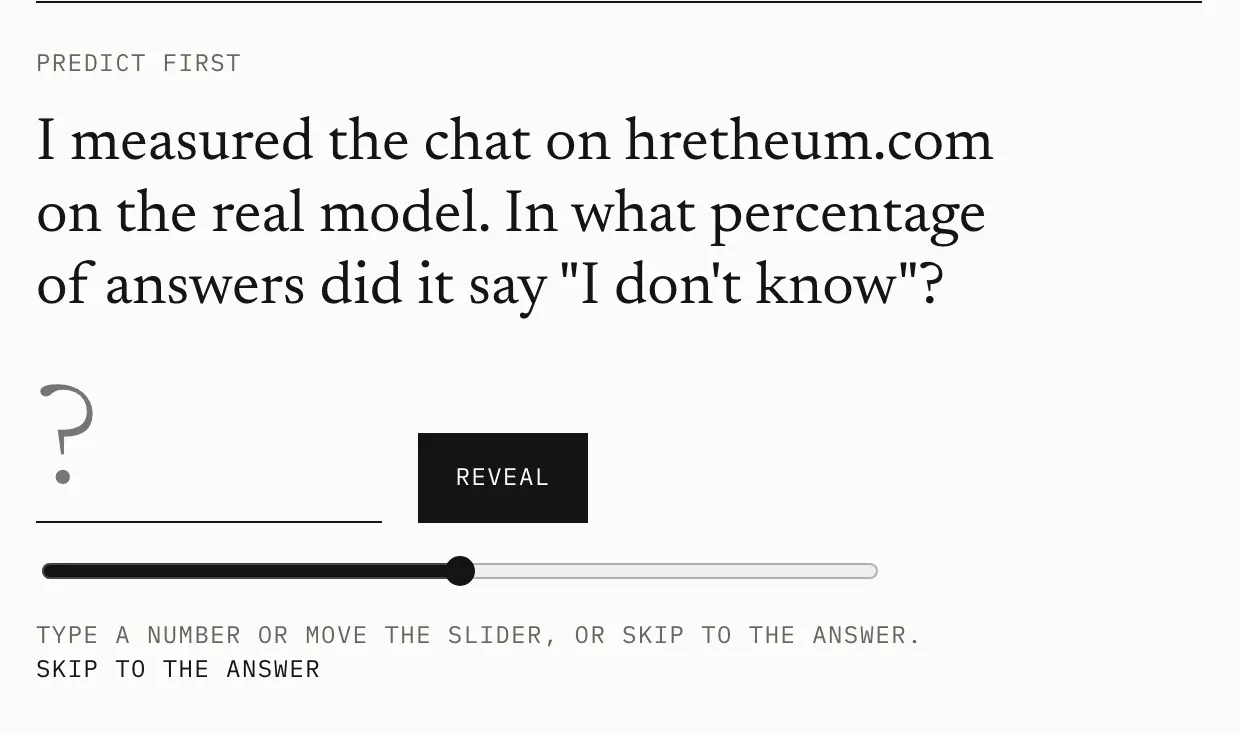
Before you read on, try a guess. My site has a chat that answers only from my profile. I measured it on a real model. In what percentage of answers did the chat say "I don't know"? Pick a number.
The answer: 3.3 percent. The chat also gave no fact from outside the profile, and the slowest 5 percent of answers took 9.5 seconds. These statements come from my profile, and each carries the date of the measurement, 13 October. It is only one example of setting a plain fact against what the audience expected.
Lesson 2.1 on my recruiter-facing page works the same way. There is a field for a number, with a slider next to it. A "Reveal" button shows the answer, and the line underneath says: "Type a number or move the slider, or skip to the answer."
For the person reading the fifth CV of the day
I built this page so that the person doing the hiring, who is reading the fifth CV of the day, has a chance to wake up at mine. Instead of the passive boredom of reading a PDF, I wanted to draw them into taking part, which seems to me a good way to take in new information.
The idea from early October was simple: a page for a job posting, built as a short course about me. Applicant tracking systems (ATS) are built for efficiency and cut handling time to a minimum. Learning works the other way round: it holds attention and asks you to do something. A note written by hand stays in the head longer than one that was only read. The form is also meant as proof of skill: this is how I would design learning on an e-learning platform.
The course takes about six minutes and has nine points on the progress bar, that is eight lessons and a final check. You guess a number before you see it. You complete a sentence with a gap. After a short quiz you get an explanation with a quote from the source. You write notes that stay in your browser. At the end you say in one sentence what you know about me, as if telling your manager, and you get a certificate. It states that this is not an accredited qualification and that it certifies only that you now know more about me than most recruiters.
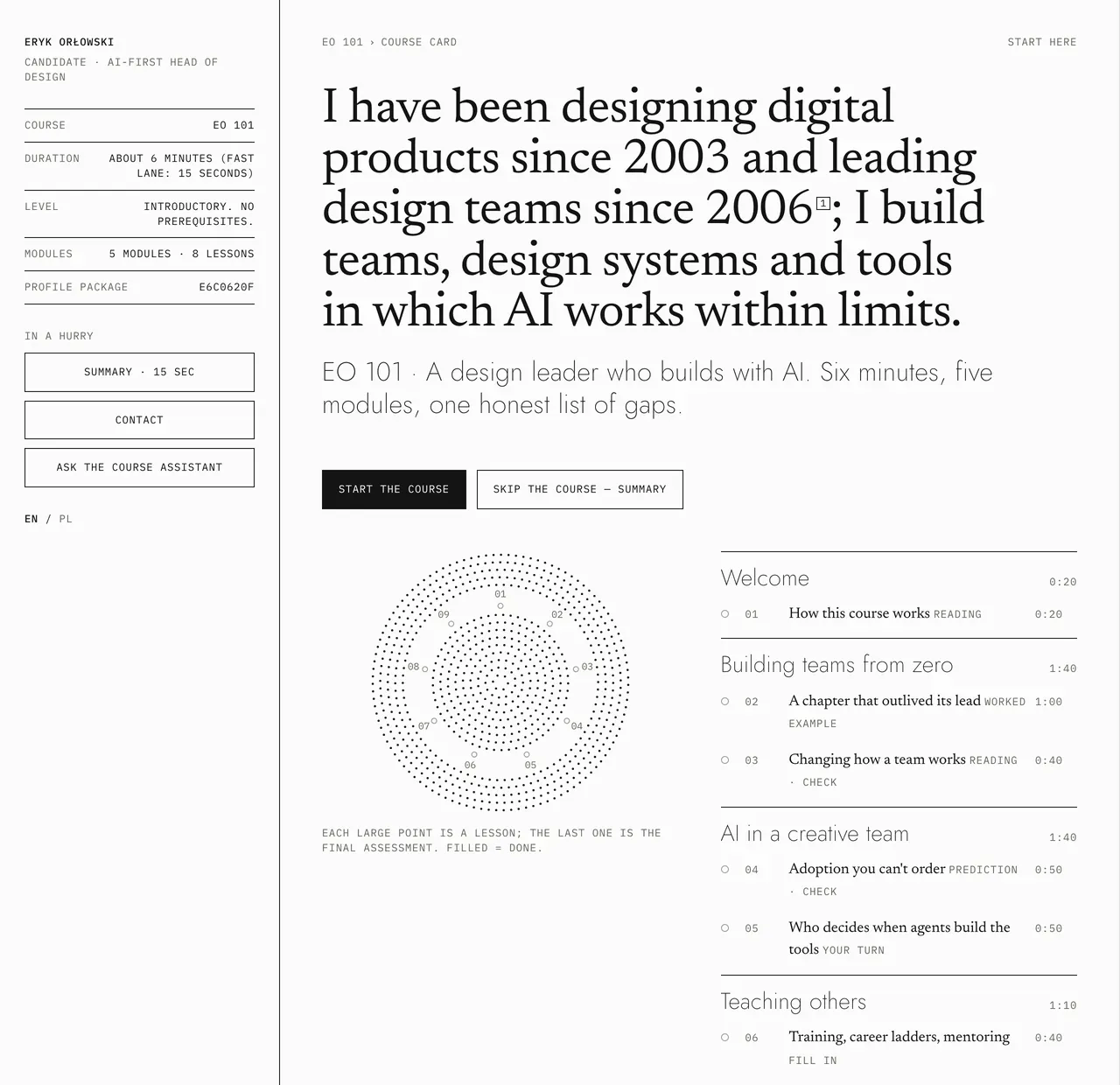
An AI agent laid out the platform elements and the learning mechanisms. My part was to approve the course as the default way into the page. The concept had two hard conditions. The metaphor has to be clear in five seconds to someone who has never designed learning, so the page uses signs familiar from e-learning platforms. And there is a fast lane: the thesis in one sentence and the buttons for the CV and for contact are visible on every screen, and no fact waits behind an exercise. The course is an invitation. It does not hold anyone back.
Two days from idea to production
AI agents did the rest. The decisions were mine.
Looks first. Gatefold, my program in which agents design screens, had earlier prepared 12 typical course screen patterns. They assumed 12 lessons in four modules, while my course had eight lessons in five. I decided the content mattered more, so the screens were fitted to eight lessons.
Then the code, built by an agent from a brief written out of my notes. A second agent reviewed the whole. I decided on the release myself, even though one automatic check was red. That check compares how the page looks with the previous version. The red came from the two sides of the comparison holding different data about my profile. With the same data there were no differences. On 10 October the course was running in production.
Right after that I reported three fixes.
The first was about the name. After the certificate of completion was generated, the text did not change, and the PDF came out without the person's name. The app looked for English-language patterns, and that failed in the Polish variant.
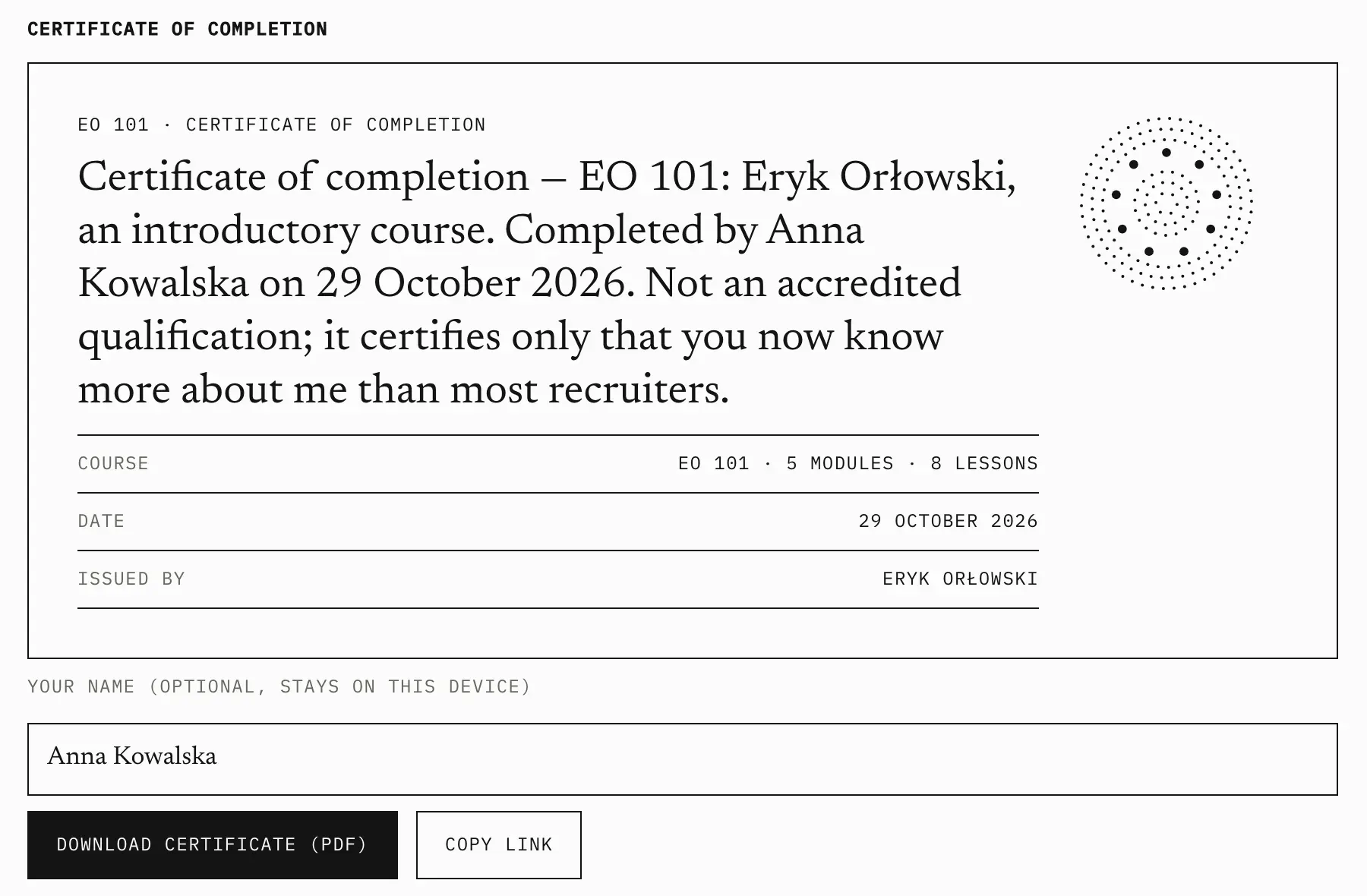
Second came the Polish diacritics in the same PDF. At first I decided that ł replaced with l could stay. A day later the PDF got proper fonts and the Polish characters came back.
Third came the link to the assistant. If such a link sent the question by itself, someone could hand a visitor a crafted link. It would use up the visitor's limit of questions and cost me paid model answers. Now the question is sent automatically only when someone clicks a suggestion on the page.
Whether the course helps in a conversation with HR, I do not measure in this text (unless I start). The course counts only aggregate events, such as a finished lesson or a passed final check, and only when the visitor agrees.
Gaps should be visible
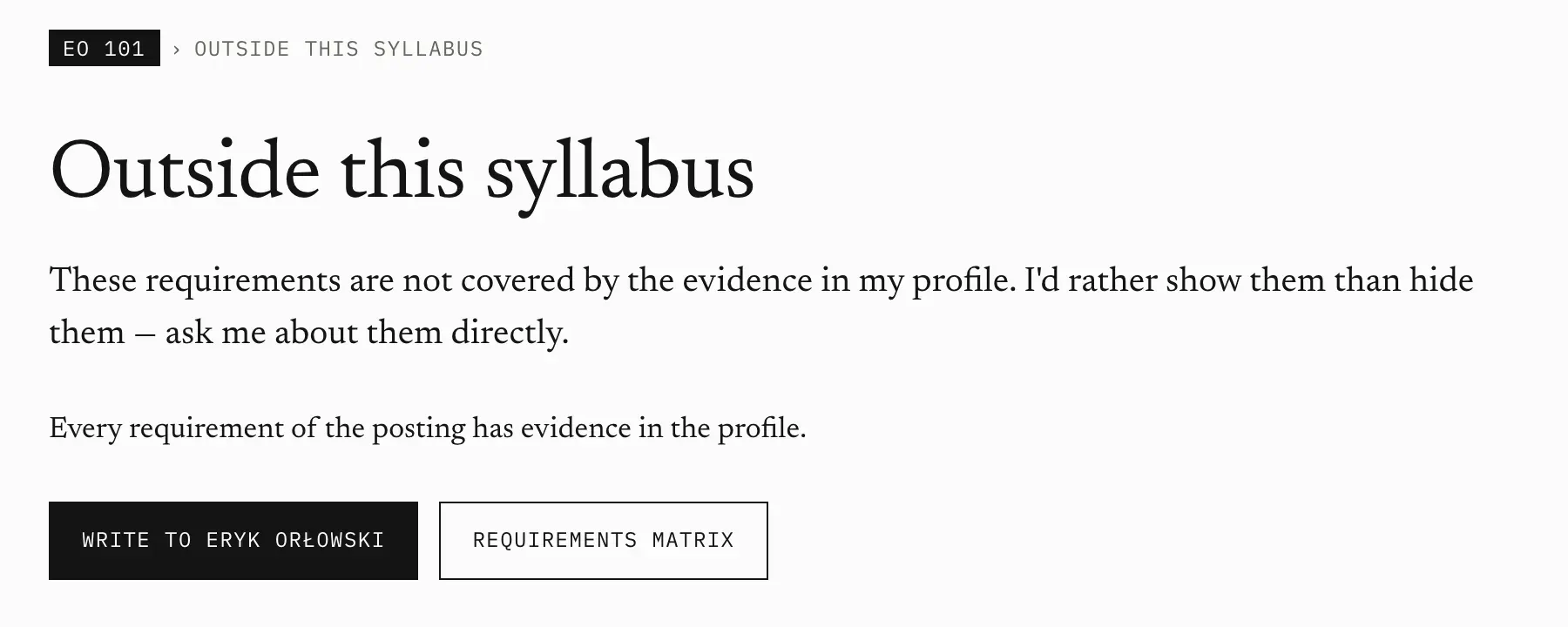
The course has two rules that have nothing to do with learning. First, nothing goes to production without confirmation: every fact has a source with a quote, and an unconfirmed one will not pass the check the site goes through before it reaches the web. Second, transparency: the page shows the requirements I do not meet. On one of the real pages the same check showed a match of 18 out of 20 requirements and listed the gaps outright.
The public demo, eo101.hretheum.com, cannot use a real posting. I left generic data in it, composed from the positioning of my profile: nine requirements and five responsibilities for the role of "AI-first Head of Design". I open its "Outside this syllabus" page. Above the empty space stands a sentence: "These requirements are not covered by the evidence in my profile. I'd rather show them than hide them." Below it is another: "Every requirement of the posting has evidence in the profile."
Take the course: eo101.hretheum.com. It takes about six minutes.
AI agents drafted this text. I edited it and checked the facts.
Behind the scenes of this text
Every post in Experiments goes through a series of checks before it reaches a reader, and this one did too. Below they come in order: what I do at each stage, what risk it guards against, and what turned up in this text. At the end is a box about a tool for policing language, which someone else invented.
- Thesis and reason for writing. Before a draft exists, I write down in one sentence the thesis, the answer to "why now", and a sentence that begins "I am writing this because…" and holds something that surprised me, cost me, or changed my mind. This guards against a text written only because writing something seems expected. Here the reason is a person reading the fifth CV of the day, and my wish that they have a chance to wake up at mine. The first version had a different thesis, about an empty list of gaps on the demo. I changed it after reading the draft, because that was not the point of the course. The first thesis stayed in the text as a single episode.
- Is this the same text again. Before editing, I compare the draft with the latest texts on the blog and in the queue. I look at how they open, how many subheadings they have and which, how long the parts are and how they end. If the draft repeats the pattern of the previous one, I change the form or explain why it stays. The form should come from the material, and there is no template. The rule comes from a remark I made on 5 October 2026: a fixed structure gives dull, identical texts. I have no program for this. An agent and I do the comparison, in writing. It is not the same as the sentence-rhythm check in stage six. Here I judge the build of the whole text, there single sentences, their repeating word order and the glut of connectors. Both are sometimes called monotony, and they catch different things.Here the result is mixed. This one opens differently: instead of a scene or a confession there is a question to the reader, with a number to guess. It has fewer subheadings (three, where recent posts had four or five) and runs shorter, at about 700 words against 800 to 900. The two days of building, though, read again as a report in the order of the work, as in several recent texts. The last two short sentences turn a quote from the page, much like the ending of the draft about the day the page collided with my profile. I decided that the opening and the axis of the piece set it apart enough. If the next text opens with a report again, I rewrite the middle.
- Agents write the draft. An AI agent writes the first version only from documents and the repository's change history. The risk is an invented fact or an invented feeling. So a missing fact gets a marker instead of a guess, and a text with a marker goes no further. In this text the only statement about my motives comes from my own remark on the first version of the draft. The agent added nothing of its own. It also gives no date for the public launch of the demo, because the material has none.
- Did the technical detail stay in the boxes. A simple script cuts out the "Tech deep dive" boxes and searches the rest for jargon, such as names of tools and formats. The aim is that the main text can be read without the boxes. In this text the script found nothing outside the boxes: the description of the parser, the matching model and the overlay files all sit in boxes.
- A reader from outside. A second agent reads the text without the boxes as a head of product at a company that builds something with AI. It points to sentences it does not understand, places with no decision or number, paragraphs where it gets bored, and passages that sound like a template. It corrects nothing. For this text, a working pass before this stage had already found the word "engine" used before anything explained it, and "building", which I swapped for plain words.
- Sztuczny Miodek. A machine scanner and a judgement pass check the language and the traces of writing on autopilot: empty openers, lists of three, a contrast tacked onto every sentence. In this text it caught two lists of three and one short sentence with a contrast. Both are rewritten. The tool returns PASS or FAIL, and "PASS with remarks" counts as FAIL. A description is in the box below.
- Name scan. I search the text for names of clients, employers from postings, and working names of products. Clients and employers from postings stay anonymous, even in descriptions that would let someone recognise them. My own product may be named, but with a note that it is mine, as with Gatefold in this text. That is why I write here about "a real posting" and "one of the real pages".
- Numbers and dates against the source. I check every number and date in a document, a report or the repository, and in the English version the numbers must match the Polish one. In this text that covers, for example, the result of 3.3 percent "I don't know" answers, the coverage of 14 of 14, eight lessons in five modules, and the dates when facts were confirmed. What cannot be confirmed does not enter the text as fact.
- List of things to confirm. Everything the agent could not check goes on a list of questions to me. One example from this text: whether I allow my remark about the person reading the fifth CV to be quoted in the first person, almost word for word. Another: who exactly composed the posting for the demo. The source says only that it was built from the positioning of my profile, so the text stays silent until I answer.
- My approval and a day's pause. I read the text and decide on the thesis and on the facts from the list. At least 24 hours pass between approval and publication, with one more read from me. No answer from me does not mean consent, so no stage moves on by itself.
- A draft on the blog and publication on command. The text lands on the blog as a working draft. It is published only on my explicit command. Under the text stands a statement that AI agents prepared the draft, and that I did the editing and the fact-checking. If after publication a fact or a number turns out to be wrong, I correct it and add a dated note at the end.